-

Email Us
sale@lscmagnetics.com -

Contact Number
+86 -13559234186
Email Us
sale@lscmagnetics.comContact Number
+86 -13559234186

When shopping for a magnetic filtration system—or evaluating one already in service—you’ll quickly run into two units of measure: Gauss (G) and Tesla (T). Both are used to describe magnetic field strength, but what’s the difference between them, and how do you convert one to the other? This article clears up the confusion once and for all.
To understand Gauss and Tesla, you first need to know the measurement systems they come from.
Tesla (T) is the SI (International System of Units) unit for magnetic flux density (often loosely called magnetic field strength). The SI is the modern global standard—meters, kilograms, and seconds all belong to it. The unit was officially adopted at the 1960 General Conference on Weights and Measures, and it honors Nikola Tesla, the inventor whose work laid the foundation for modern electromagnetism.
Gauss (Gs or G), on the other hand, comes from the older CGS (centimeter‑gram‑second) system. It’s named after Carl Friedrich Gauss, the German mathematician and physicist who built the world’s first geomagnetic observatory in 1833 and pioneered the quantitative study of Earth’s magnetic field.
In short: Tesla is the international standard; Gauss is the traditional unit. They’re like kilometers and miles—different scales for the same physical quantity.
Memorize this single equation:
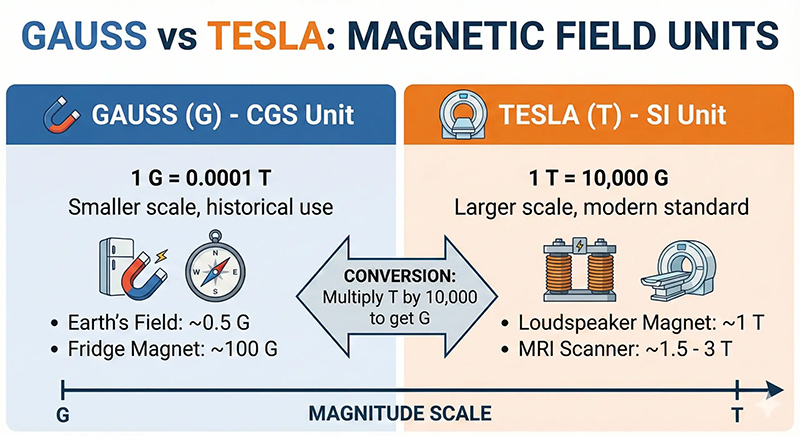
1 Tesla = 10,000 Gauss
And therefore:
1 Gauss = 0.0001 Tesla = 10⁻⁴ T
Why this odd factor? Because the Tesla is a relatively large unit—1 tesla is a very strong field—while the Gauss is much smaller. In practice, using Gauss often gives more intuitive numbers, especially in industrial settings.
For quick reference, here are some common field strengths in both units:
| Magnetic Field Source | Tesla (T) | Gauss (G) |
| Earth’s magnetic field | ~0.00005 – 0.00006 | ~0.5 – 0.6 |
| Ordinary permanent magnet | ~0.01 – 0.1 | ~100 – 1,000 |
| NdFeB (neodymium) magnet | ~0.1 – 1.5 | ~1,000 – 15,000 |
| Medical MRI scanner | 1.5 – 3.0 | 15,000 – 30,000 |
| Research‑grade water‑cooled magnet | up to 42 | up to 420,000 |
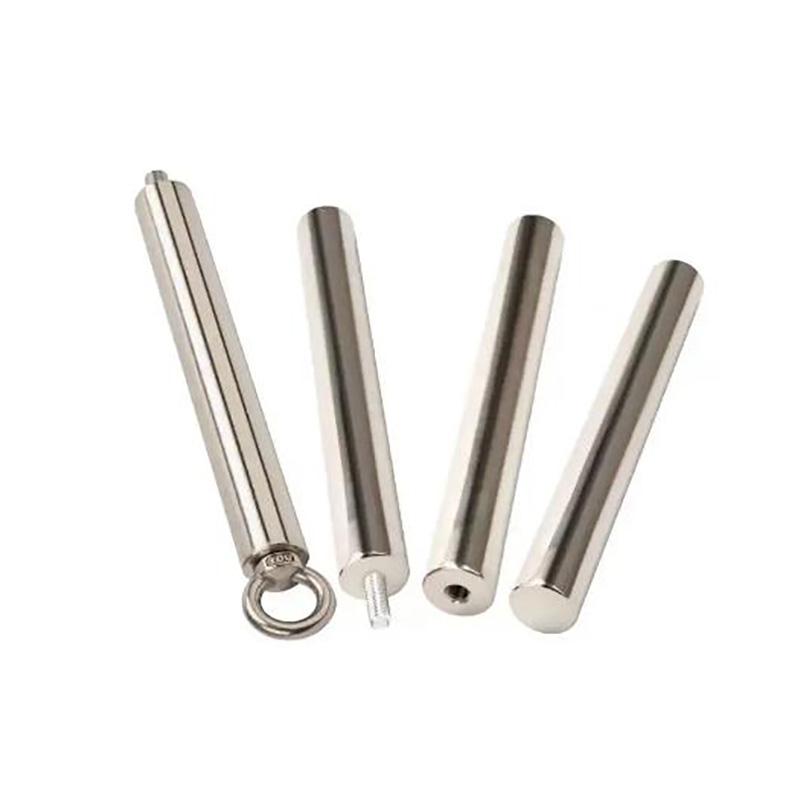
As the table shows, the Earth’s field is only about half a gauss, while a typical neodymium magnetic rod used in industrial filters can reach several thousand to over ten thousand gauss. That’s why filter manufacturers and users often prefer Gauss—the numbers are larger and easier to compare at a glance.
Strictly speaking, Tesla and Gauss are units of magnetic flux density (symbol B)—not magnetic field strength (symbol H). The SI unit for H is amperes per meter (A/m); the CGS unit is the Oersted (Oe).
The relationship between B and H involves the vacuum permeability μ₀ (μ₀ = 4π × 10⁻⁷ H/m). In practical engineering, however—especially when dealing with permanent magnets and filtration gear—people routinely use “magnetic field strength” as a catch‑all term, and they quote surface fields in Gauss or Tesla. This loose usage is so common that it’s become the industry norm.
For your purposes, just remember this: Gauss and Tesla tell you how strong the magnet’s “pull” is—the higher the number, the better it can trap ferromagnetic particles.
Since they’re interchangeable, which one should you rely on?
Check the nameplate and datasheet – Most equipment (both domestic and imported) lists both units. If only one appears, just apply the 1 T = 10,000 G rule.
Talk to suppliers in their language – In China’s magnetic filtration industry, “Gauss” or “kilogauss (kGs)” is the everyday term (1 kGs = 0.1 T). If you ask for a “3‑tesla rod,” you might get a blank stare; say “30,000‑gauss rod” and they’ll know exactly what you need.
Use Tesla in research and international standards – Academic papers and formal specifications almost always use Tesla, so stick with it there.
The magnetic rod’s field strength directly determines how efficiently the system removes fine ferrous contaminants—especially sub‑micron particles that are hardest to catch.
When assessing or upgrading a filtration system, pay attention to two things:
Surface field strength – Measure it with a gaussmeter (or teslameter) and compare to the factory rating. If the reading falls below 80% of the original value, the magnet has degraded significantly.
Field uniformity – The magnetic field should be consistent along the entire length of the rod. Inconsistent distribution creates weak spots where particles can slip through.
Finally, let’s bust a few persistent misconceptions:
❌ Myth 1: “Gauss and Tesla measure different things.”
✅ Fact: Both measure the same quantity—magnetic flux density (B). They’re just different units, like meters and feet.
❌ Myth 2: “Oersted and Gauss are the same.”
✅ Fact: In a vacuum, 1 Oe ≈ 1 G numerically, but physically they are different: Oersted measures H‑field (magnetic field strength), while Gauss measures B‑field (flux density). In ferromagnetic materials, the numbers can diverge wildly.
❌ Myth 3: “Tesla is more ‘scientific’ than Gauss.”
✅ Fact: Tesla is the SI standard, but Gauss is still widely used and fully accepted in many fields (e.g., magnet QC, geomagnetic surveys). Choose the unit that fits your context—neither is inherently “better.”
❌ Myth 4: “Magnetic field strength (H) is measured in Tesla.”
✅ Fact: The SI unit for H is A/m (and the CGS unit is Oe). Tesla is for B (flux density). While everyday conversation often blurs the line, technical documents should keep them distinct.
The takeaway: Just remember 1 T = 10,000 G, and you’ll never be lost—whether you’re reading a spec sheet, talking to a supplier, or checking your own equipment’s health. Next time you see a magnetic rod’s rating, do the conversion yourself—it’s the surest way to know exactly what you’re getting.
Whatsapp : +86 -13559234186
Email : sale@lscmagnetics.com
Tel : +86 -13559234186